
How Indian SMEs Are Automating HR Operations in 2026
Indian SMEs are looking for tangible ways to simplify repetitive HR work and improve employee service. The AI Agents for HR are enabling automation of routine workflows, transaction processing, and employee service requests in 2026. Unlike traditional tools that are used primarily to archive information, AI agents can interpret requests, pull relevant data, and execute approved tasks across integrated systems and applications. This represents a shift toward operational AI in Indian businesses.
What are AI Agents for HR?
AI agents are software systems that are programmed to perform specific tasks based on instructions, business rules, data inputs, and integrations with other applications. An HR agent may be able to respond to employee requests, verify leave balances, support onboarding, gather documents, generate reports, and forward requests to appropriate experts.
However, the key difference between an AI agent and a traditional software application is that an agent can move beyond answering a question or providing information to take action. With appropriate integrations, an agent can pull data and initiate a predefined workflow without requiring manual input from an end-user or HR professional. This is particularly useful for repetitive HR processes that involve multiple steps.
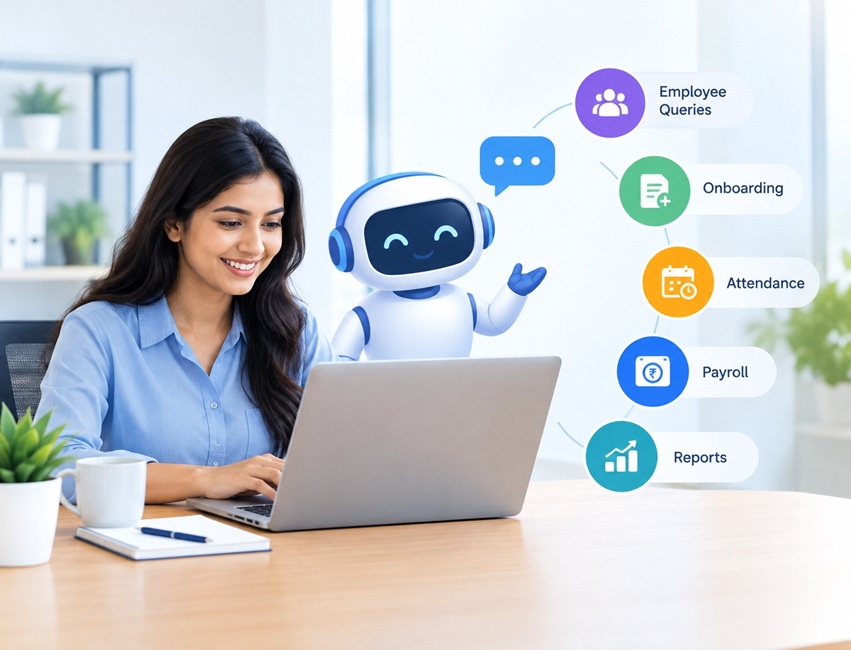
Automation of employee queries
HR teams can devote a lot of time to responding to routine questions. Employees may inquire about leave balances, payroll documentation, attendance records, benefits, company policies, and more.
An AI-enabled HR agent can support self-service queries to reduce HR team involvement. Employees can interact via supported messaging or chat platforms to get answers without needing to wait for HR support.
This is not intended to eliminate HR roles but rather to enable HR teams to spend less time on repetitive queries and more on strategic involvement and engagement.
Onboarding involves a variety of repetitive activities. HR teams need to gather documents, communicate policy updates, update employee profiles, and coordinate activities with other departments.
Streamlining employee onboarding
AI-enabled HR agents can help coordinate these activities by prompting new employees about outstanding documents, providing onboarding information, and reporting task completion back to HR teams.
Managing integrated attendance and payroll processes
Managing attendance can be an additional HR activity to automate using an AI-enabled platform. Employee attendance, leave, hours worked, and overtime can be integrated into payroll.
An AI HR system can identify missing attendance data or anomalies for inclusion in payroll processing, as well as to route issues for review instead of HR teams doing manual checks.
This does not mean that an AI-enabled system should be making all payroll decisions, but rather that financial consequences should be subject to validation and human review where appropriate.
Supporting recruitment processes
An AI-enabled tool can also provide support to recruitment processes. It can help triage applications, communicate with candidates, schedule interviews, and provide status updates.
For a SME with limited HR resources, automation of HR administrative processes can help make candidate engagement more manageable. Decisions should be based on transparent criteria and involve human review where necessary.
Enhancing HR reporting
HR data management can be difficult when information is stored across platforms. An AI-enabled HR tool integrated with HRMS platforms can support data pull and provide summarization services.
For example, HR managers may need a report on headcount, leave, attendance, or other workforce metrics. Instead of manual aggregation, an AI-powered system can help synthesize relevant data sources.
Why AI Agents are relevant for Indian SMEs
Many SMEs have a small HR team. As employee numbers grow, the burden of admin work can increase rapidly. Automated workflows can enable organizations to scale without proportionately increasing manual work.
A 2026 study suggests that Indian businesses are shifting from pilot projects toward operational deployments, although there are still challenges related to skills, data integrity, governance, and security.
For an SME, the initial practical steps usually involve identifying straightforward workflows, deploying automation for those workflows, and expanding from there.
Transparency and Human Involvement Remain Critical
AI agents should not be deployed without appropriate controls in place. HR-related workflows involve sensitive information and may impact employees directly.
Employers should develop policies on what tasks can be left to an AI agent and what tasks require human approval. Security considerations, data management, auditability, and data quality are also important to consider.
In particular for matters such as new employment, promotion, salary processing, or discipline, a combination of AI automation and human review will be necessary.
Watch Now: Introducing TeamsMaster AI Pvt Ltd – The Future of Smart Team Management
The Future of HR Automation
AI-enabled agents are transforming the traditional HRMS focus on static record storage toward dynamic workflows and task execution. For Indian SMEs, the greatest value may come from reducing administration work to free up HR resource time to focus on their core people management functions.
Integration of attendance, payroll, performance, employee relations, and reporting functions should accelerate, as well as help SMEs achieve greater scale in their HR operations. With clear use cases, governance rules, and human oversight, SME HR teams can begin to benefit from AI agent automation.