
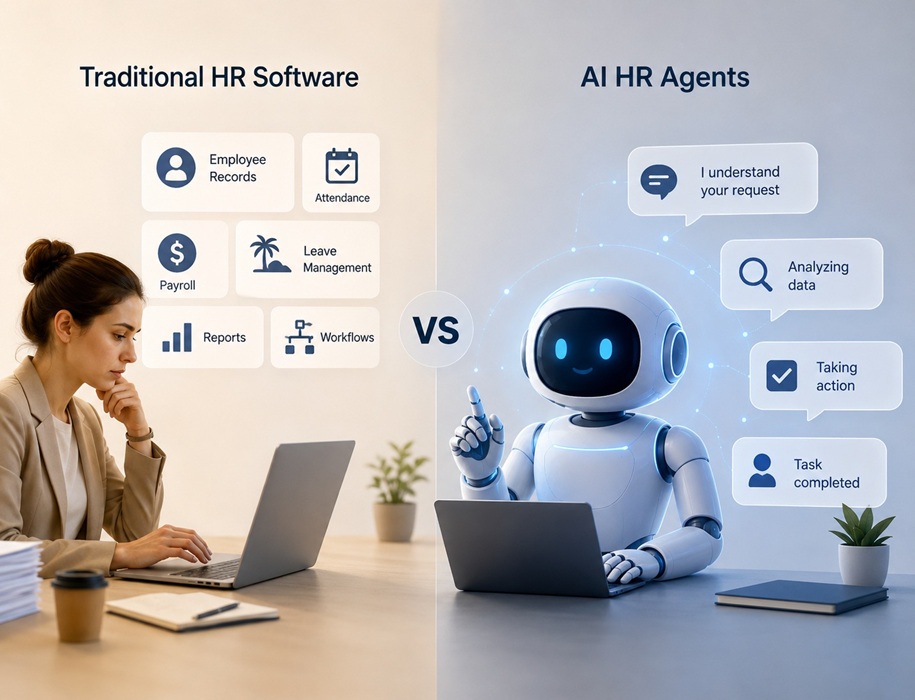
Human resources technology is changing rapidly in 2026. Traditional HR software has helped businesses manage employee records, attendance, payroll, recruitment, leave, and performance for years. However, AI HR agents are introducing a different approach—one where software can understand requests, make decisions within defined rules, coordinate tasks, and take action across workflows. The key difference is that traditional HR software generally helps people operate processes, while AI agents can increasingly execute processes with limited human intervention.
What Is Traditional HR Software?
Traditional HR software includes HRMS, HRIS, payroll platforms, attendance systems, recruitment tools, and employee management applications. These systems centralize workforce information and automate predefined activities.
For example, an employee may use an HR portal to apply for leave. The system follows a configured workflow, sends the request to the manager, updates the leave balance after approval, and records the transaction.
This model is reliable for structured and predictable processes. Businesses can use it to manage:
Employee records
Attendance and working hours
Payroll processing
Leave and holidays
Recruitment workflows
Performance management
Employee documents
Compliance records
HR reports and analytics
However, traditional software usually requires users to navigate dashboards, menus, forms, and different modules to complete tasks. This can create friction when HR teams manage large or complex workforces.
What Are AI HR Agents?
AI HR agents take automation a step further. Instead of simply following a fixed sequence of instructions, an AI agent can interpret a goal, determine the steps required, interact with connected systems, and execute actions according to its permissions and guardrails.
For example, instead of manually checking attendance, calculating exceptions, identifying payroll issues, and notifying employees, an AI HR agent could analyze the available workforce data, identify unusual cases, prepare actions, and escalate situations that require human approval.
The technology is still developing, but AI agents are increasingly being positioned as an execution layer within HR technology rather than simply another chatbot or reporting feature.
AI HR Agents vs Traditional HR Software
The biggest difference is how work gets completed.
| Feature | Traditional HR Software | AI HR Agents |
| Interaction | Menus, forms and dashboards | Natural-language interaction |
| Automation | Predefined rules | Goal-based and adaptive workflows |
| Task execution | Usually user initiated | Can be trigger or goal initiated |
| Decision-making | Fixed business rules | Context-based decisions within guardrails |
| Workflow | Mostly linear | Can coordinate multiple steps |
| Data usage | Reporting and transactions | Analysis plus action |
| Exceptions | Often require manual handling | Can identify and escalate exceptions |
| Human role | Operates and manages the system | Supervises, approves and handles complex cases |
Traditional automation remains valuable because predictable processes benefit from consistency and control. AI agents are more useful when workflows involve changing information, multiple systems, or several steps requiring contextual decisions.
Key Benefits of AI HR Agents in 2026
1. Faster HR Operations
AI agents can reduce repetitive administrative work by handling routine requests and coordinating multiple workflow steps. HR professionals can spend less time searching for information or manually moving data between systems.
2. Natural-Language Employee Support
Employees can interact with HR technology using everyday language rather than learning complex software interfaces. An employee could ask about leave balances, attendance, policies, or payroll information and receive a contextual response.
3. Proactive Workforce Management
Traditional systems generally wait for someone to initiate an action. AI agents can potentially monitor workflows, identify issues, trigger appropriate tasks, and escalate exceptions. This creates a more proactive HR operating model.
4. Better Integration
Modern AI agents can work across connected applications and coordinate multiple actions. This can be particularly useful when recruitment, onboarding, attendance, payroll, and employee management are spread across different systems.
5. More Strategic HR Teams
By reducing repetitive administrative work, AI can give HR professionals more time for workforce planning, employee development, engagement, and organizational strategy. SHRM’s 2026 research also emphasizes that AI works best when combined with human judgment, experience, and empathy.
Are AI HR Agents Replacing Traditional HR Software?
Not necessarily. In fact, the two technologies are likely to work together.
Traditional HR software provides the system of record where employee information, attendance data, payroll records, policies, and other critical information are stored and managed. AI agents can operate on top of these systems to make that information easier to use and turn it into actions.
This means businesses should not necessarily think of AI agents as a complete replacement for HR software. Instead, the future may involve a combination of a reliable HR platform and intelligent agents that interact with it.
What Should Businesses Choose in 2026?
The right choice depends on business requirements.
Traditional HR software may be sufficient when a company needs dependable employee records, payroll, attendance, leave management, compliance, and structured workflows.
AI HR agents become particularly valuable when businesses want conversational access, proactive automation, cross-system workflow execution, intelligent recommendations, and reduced administrative workload.
However, businesses should evaluate AI capabilities carefully. Not every product marketed as an “AI agent” provides genuine agentic functionality; some may simply add AI chat features or rebrand conventional automation.
Security, permissions, audit trails, human approvals, and clear accountability are also essential when AI systems can take actions affecting employees. Organizations should establish appropriate governance before giving agents significant autonomy.
The Future of HR Technology
The future of HR is unlikely to be completely traditional or completely autonomous. Instead, businesses are moving toward AI-powered HR platforms where humans and intelligent systems work together.
Traditional HR software provides structure, reliable data, and controlled processes. AI HR agents add intelligence, natural-language interaction, proactive execution, and workflow coordination.
As businesses move through 2026 and beyond, the competitive advantage will come not simply from having HR software, but from using technology that can turn workforce data into meaningful actions while keeping humans in control of important decisions. Gartner projects that AI could perform up to half of current HR activities by 2030, highlighting the scale of the transformation ahead.