
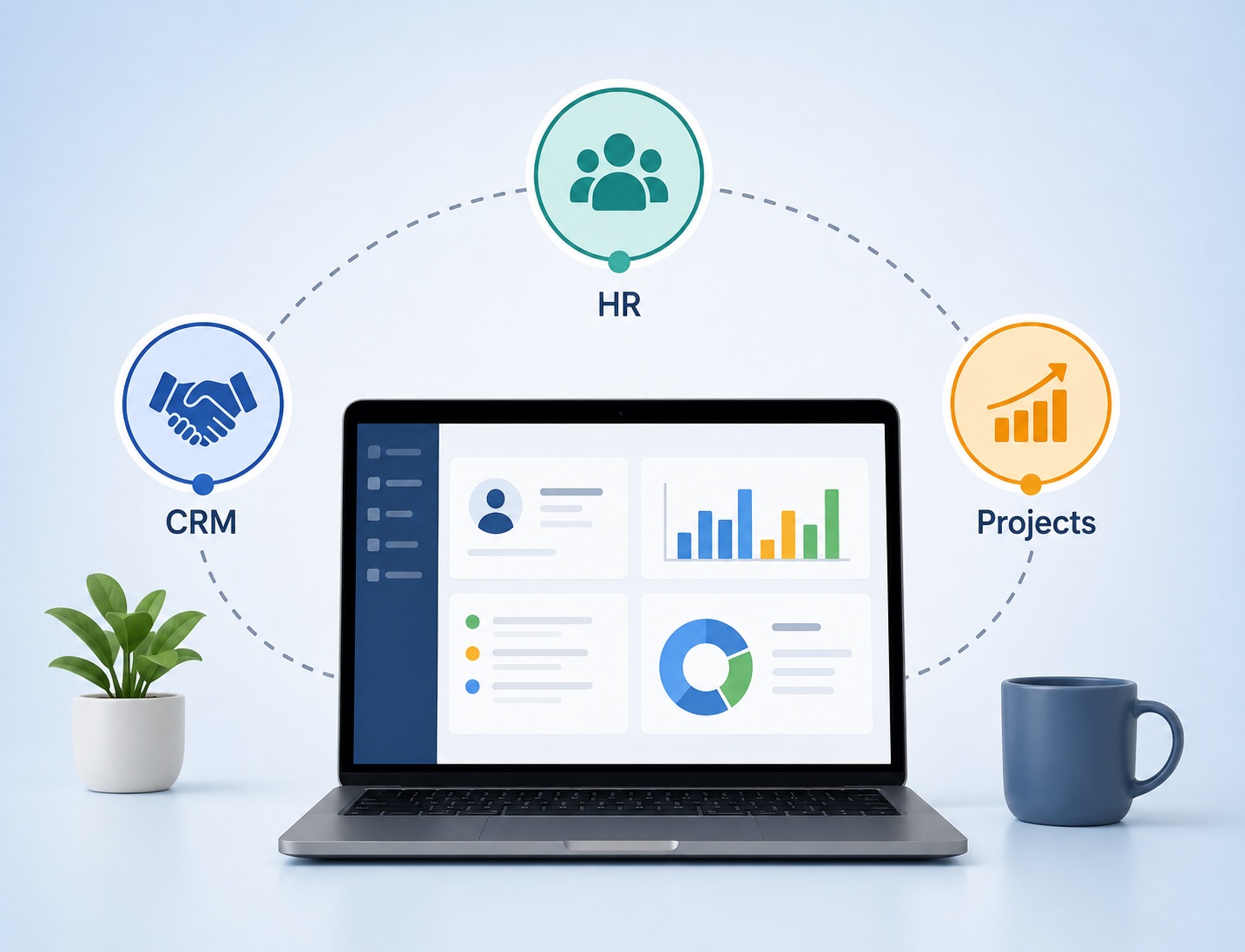
Small and medium-sized businesses (SMBs) can fall into the trap of using separate software tools for HR, CRM, payroll, and project management. While using individual tools for specific needs might be efficient at first, managing multiple systems can lead to higher costs, redundant data, and complex day-to-day operations. Thankfully, all-in-one HR, CRM, and project management software are becoming a practical solution for SMBs seeking to streamline their people, customer, and project management from a single, connected platform by 2026.
Why SMBs Need All-in-One Business Software
Managing employees and customers gets challenging as your business grows, especially when employee and client data is scattered across different applications. HR teams might rely on one system for attendance and payroll, the sales department on another for CRM, and project managers on yet another for tasks and deadlines.
This fragmented approach presents several problems, including:
Duplicate employee and customer data
Manual data entry between platforms
Difficulties in tracking business performance
Increased costs for software and integrations
Limited visibility across different departments
More time spent switching between applications
An integrated platform consolidates these functionalities, enabling businesses to manage their operations from a connected system.
What is All-in-One HR, CRM and Project Management Software?
All-in-one business software combines multiple functional areas into one platform. Instead of utilizing separate applications for employee management, customer relations, and projects, businesses can access these capabilities from a single system. A modern platform often encompasses:
HR and employee management
Attendance and leave management
Automated payroll
CRM and sales management
Project and task management
Expense management
Invoicing
Business reporting
Mobile access
AI assistance
The primary benefit is that data is interconnected. Employee information, customer activity logs, project assignments, attendance records, and other operational data work together, rather than being isolated.
Key Features SMBs Should Look For
1. Integrated HR Management
Essential employee operations such as records, attendance, leave tracking, performance management, and payroll should be covered under the HR functionality. A centralized HR system helps reduce repetitive administrative work and allows managers to gain a better overview of the workforce.
2. Automated Payroll
When attendance and employee data are directly linked to payroll calculations, processes become simpler. Automation reduces manual calculations and minimizes the risk of errors commonly associated with spreadsheets and disconnected systems. For field-based employees, GPS attendance features can verify work locations and times.
3. CRM and Sales Management
A built-in CRM helps sales teams manage leads, contacts, follow-ups, and opportunities within the same system. Connecting CRM data with project management seamlessly transitions the process from customer acquisition to project delivery.
4. Project and Task Management
The software should offer easy-to-use features for project creation, task assignment, deadline tracking, and progress monitoring. This gives managers a clear view of which team members are involved in specific projects and where any potential delays may occur.
5. AI and Voice Assistance
By 2026, AI is becoming a staple in business software. Managers can use AI-powered tools to quickly retrieve information and complete routine tasks, eliminating the need to sift through multiple dashboards. Voice command integration adds another layer of convenience.
6. Mobile and Remote Accessibility
Given the rise of remote and hybrid work models, SMBs require software that employees can access from various locations – office, home, or client sites. Mobile-friendly platforms ensure accessibility for everyone.
Benefits of Using One Platform
The most significant advantage is the simplicity of using a single system for multiple critical operations. Beyond this, other benefits include:
Lower software complexity: Fewer logins, integrations, and administrative tasks to manage.
Better data visibility: Managers can see an integrated view of HR, sales, and project data.
Reduced manual work: Automation streamlines tasks like attendance calculations, payroll, and reporting.
Improved collaboration: HR, sales, and project teams can work with unified, shared information.
Scalability: The platform can adapt and grow with your business as your operations expand.
Why TeamsMaster Could be a Strong Choice for SMBs
TeamsMaster promotes itself as an integrated business solution that combines HR, CRM, project management, payroll, attendance, and other business functions. Their aim is to eliminate the need for separate, disconnected software applications. For SMBs with employees across various departments and locations, such a unified platform can be invaluable.
Features like GPS attendance and payroll automation, integrated CRM, and AI capabilities help centralize day-to-day operations.
The real value lies not in having a single login, but in connecting data across departments to drive processes forward more efficiently.
How to Choose the Right Platform in 2026
When selecting an all-in-one solution, SMBs should consider:
Core features: Does it cover essential HR, CRM, payroll, and project management needs?
Integration: How well do the modules work together and share data?
Automation: Can it automate repetitive administrative tasks?
Mobile support: Is it accessible on various devices for all team members?
Security: What measures are in place to protect employee and customer data?
Scalability: Can the platform grow with your company’s needs?
Pricing: Is the total cost competitive with using separate tools?
Ease of implementation: How quickly can your team adopt the new system?
Reporting: Does it offer insightful business analytics?
Support: Is customer assistance reliable and readily available?
Conclusion
By 2026, SMBs don’t need more software; they need better-connected software. An all-in-one HR, CRM, and project management platform brings together employee management, customer relationships, payroll, attendance, and project operations into a single, unified environment. For growing businesses, this approach simplifies operations, enhances visibility, automates tasks, and fosters collaboration. When choosing a platform, prioritize its ability to integrate functions and share data effectively, not just the breadth of its features.