
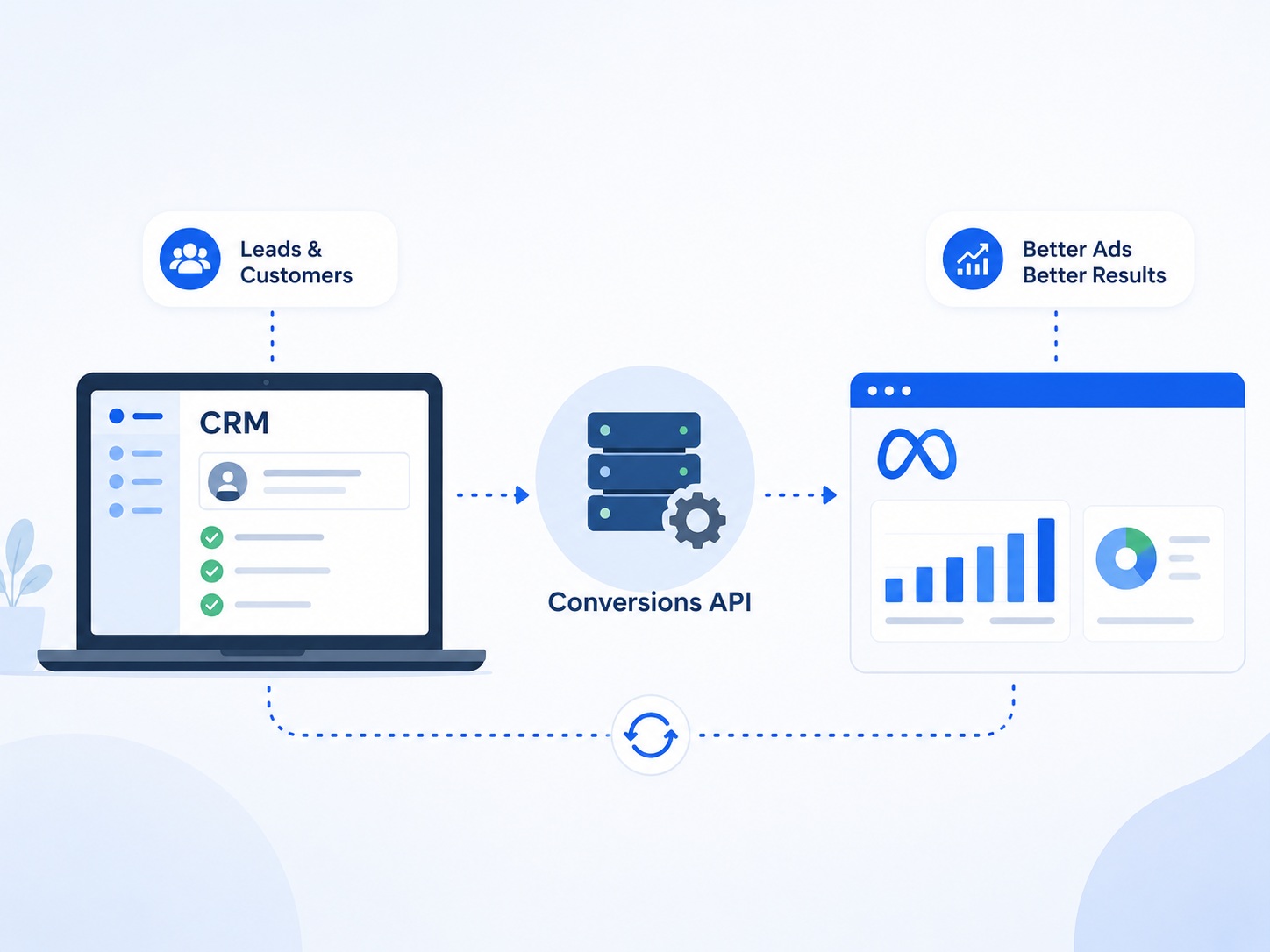
Marketers have already succeeded in lead acquisition – now their objective should be analyzing lead progress and future performance as well as the revenue produced by these leads. Meta Conversions API for CRM helps businesses to link their CRM and Meta advertisements, allowing them to send events-like leads becoming prospects and even becoming clients or generating income-directly to Meta. Different from simply tracking on the browser, it sends data from their servers and Crm. This provides the companies a fuller picture of their client sales-cycle.
What exactly is the Meta Conversions API for CRM?
The Meta Conversions API, CAPI, enables the send of business and conversion events from the server directly to Meta, once integrated with a CRM. Businesses can transmit pertinent events such as new leads, qualifying opportunities or potential/existing customers.
This solution is very useful for those who promote ads on the Meta platform, since leads submit forms that can take days or weeks to evolve into a selling. Linking CRM and Meta aids in delivering clearer signals to the advertiser on the results subsequent to the form submission. This is why Meta itself suggests CAPI integration with CRM.
The benefits of connecting CRM and Meta advertising
Current advertising reports only use impressions, clicks, and the number of submitted forms in order to get a general outcome. The results these indicators lead to the creation of revenue.
Through CRM, businesses have reliable first-party details about the entirety of the sales flow. When these details are sent to Meta, it can interpret these quality-driven signals better:
Increased quality of leads: Meta can now take info regarding qualified leads-not just simply about a form completion.
Better optimization of ads: Once aware of quality leads, ads can be targeted more accurately toward those more likely to finalize a transaction.
More precise attribution: Using CRM data to analyze and connect advertising activities to the subsequent client experience makes tracking more reliable.
Independence from browser tracking: The server can send the data, not having to be solely dependent on browser tracking techniques.
Greater client insights: Both sales and marketing departments can get a clear image regarding campaigns influencing valuable client sales. Meta itself teaches that improving leads through their advertising through CAPI integration can bring great benefit.
How the Meta CAPI for CRM works
The fundamental process is relatively easy:
Meta Ads Lead CRM Sales Activity Conversion Event Meta
At the point that a potential client notices an ad and fills out a form, their lead information is now logged in the CRM. The salesperson can then interact with the client and keep track of his/her status.
Through CAPI, Meta receives signals concerning what transpired during the subsequent phases of the funnel, giving Meta clearer data regarding the client’s quality, and development status. It could use one of several integrations: direct integration with a supported CRM, use of an automation tool, or a custom API integration-based on your CRM or technical proficiency.
Meta pixel and CAPI – what is the distinction?
Meta pixel and CAPI are distinct and can complement one another. While the Meta pixel tracks all activities taking place on the browser, CAPI can receive data from the CRM directly or from the server. With the two integrated, businesses achieve much better measurements. The significant thing to know is that CAPI isn’t a complete replacement to all other forms of tracking-it’s rather a complement to browser-based tracking but with CRM and offline data input.
Major advantages of CRM-linked CAPI for today’s enterprises:
A CRM-linked CAPI configuration is most useful for those that have longer sales cycles. For example, there are few of those who were advertised, who end up as bona-fide customers even if many filled up a lead form. Using the business logic about how a client transitions between sales stages by sending it over through CAPI signals more precise information than leads obtained directly off a form would, separating actual prospects from inquiries. Benefits include:
1. Enhanced meaning to conversion data
2. Clearer measurement for lead quality
3. More efficient advertising campaigns
4. Tightened alignment among marketing and sales departments
5. Greater insight into client sales cycles
6. Improved utilization of ad data
Meta have claimed CAPI integration can result in great improvements and reduction in cost, associated with obtaining quality leads.
Drawbacks in implementation:
Though the concept is valuable, implementation is not as simple as it may sound. It’s a crucial to guarantee that CRM events are matched precisely to the ones that are desired to be tracked and that the provided data accurately reflects what is intended to be shared. Problems can come in numerous forms: inconsistent led statuses, non-complete CRM records, inaccurate event linking, redundant duplicate signals, or insufficient testing.
Legal restrictions and client data usage guidelines must also be examined preceding to sharing customer data.
Efficient application demands close communication amongst marketers, sales, IT administrators, and development staff.
How TeamsMaster AI Pvt Ltd Can Assist
TeamsMaster makes use of both a Crm and your business functions at one same place in order to give businesses more control regarding their client data and the transactions it produces. Linking their client CRM data with ad mediums similar to Meta could significantly diminish the need for physical data recording and enhance overview along the whole lead pathway. By using automate marketing tool in your CRM your business could effectively manage it’s lead information and provide marketing performance analysis with clearer insights into client data.
Watch Now: CRM Platform for Smarter Field Team Management – TeamsMaster AI Pvt Ltd
Conclusion:
Meta CAPI for CRM becomes a critical component for modern organizations that are looking beyond the results generated by simply acquiring a lot of leads. By providing Meta signals of events along a client’s lifecycle using your CRM information, you are giving Meta more precise signals regarding how leads convert into clients.
The most significant success can come from using clean CRM data, intelligent mapping of the events, right setup of things, and observing at all periods. Businesses using Meta Ads campaigns, for example can significantly leverage integration from marketer to salesperson; for a better business operation, to produce the best outcome.